End of commercial whaling in the Azores
The WhaleThe end of commercial whaling in the Azores in 1986 closed a local industry that had grown from skills borrowed from earlier whalers into a source of work for island communities. Its ending was not a single dramatic break: dwindling demand and new employment weakened the trade, while the European Union’s prohibition supplied the final pressure. In its place, whale watching turned the living animals from quarry into the focus of a new visitor economy.
An Industry Built on Borrowed Practice
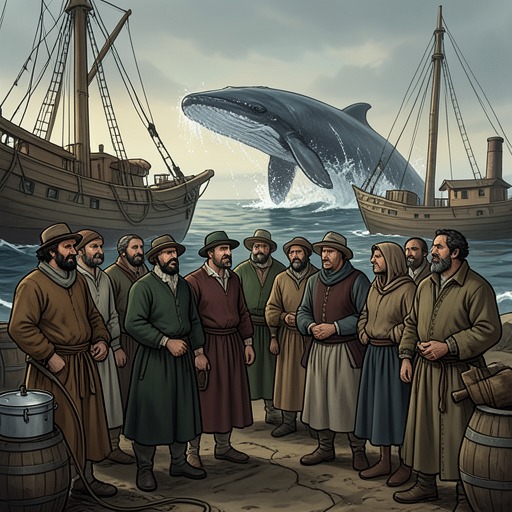
Whaling began in the Azores in 1850. Within a short time, one hundred crews from the islands were hunting whales with techniques learned from their former masters. This was not merely the preservation of an older tradition: islanders had established a working industry of their own, and whaling continued there until 1986, long after it had become a remnant of an earlier era elsewhere.
The late twentieth-century hunt still carried the marks of that inherited practice. Crews used boats modeled on Yankee whaleboats, while watchers stationed at clifftop vigias scanned the sea for blows that signaled whales. The contrast between old methods and newer surroundings was especially striking in film of Azorean whaling from the 1970s, which appeared to bring nineteenth-century whaling into the age of color footage.
The Trade’s Last Years
By the late 1970s, each whale was worth £500, a substantial incentive for subsistence farmers and fishermen. In 1979, crews caught 150 sperm whales off the Azores. Whale teeth also became more valuable: in the industry’s last ten years, their price rose from three to eighty dollars per kilo. Yet the trade was already fragile. Only one blacksmith remained who could forge harpoons and lances in their traditional shape, a sign that the specialized craft around whaling was narrowing even as individual products commanded high prices.
Economic incentives did not secure the industry’s future. Islanders found better work elsewhere, and the world’s appetite for whale products declined. The European Union’s prohibition of whaling delivered the final blow. The account dates the end of commercial whaling in the Azores to 1986, presenting it as the outcome of converging economic change and regulation rather than a simple disappearance of local skill or memory.
From Hunting to Whale Watching
The closure left a practical question: what work could replace whaling? When Serge Viallelle arrived from France in the 1980s after delivering a yacht, he discovered the whales and stayed. He then had to persuade islanders that visitors would pay to see whales rather than to obtain products made from them. Whale watching thus emerged not as an automatic consequence of the ban but as a trade that had to be explained and taught.
The transition connected the Azores to Provincetown, where whale watching had also replaced hunting. Al Avellar, a Provincetown resident of Portuguese descent, taught the islanders their new trade. The shift preserved a livelihood linked to whales while changing the terms of that relationship: the animal’s value increasingly lay in being encountered alive, rather than captured for sale.
Significance of the Ending
The Azorean transition shows how the end of a hunting industry can depend on several forces at once. Diminishing markets and alternative employment had already weakened whaling; European Union rules made its continuation illegal; and whale watching offered a replacement only after local people were persuaded to adopt it. The industry’s long survival—from its beginnings in 1850 to its end in 1986—also complicates any notion that whaling belonged only to a distant past. In the Azores, its final years were recent enough for former whalers to remember the work and for a new tourism economy to be built around the same animals.